Context
The project was carried out for a mobility platform operating in Cyprus. In island environments the stability of a car-sharing service depends heavily on how effectively behavioural risk is managed. The fleet is limited and every vehicle represents a valuable operational asset. Even a small increase in incident rates can quickly translate into higher repair costs and reduced availability of vehicles for customers.
The platform's users were a mix of local residents, expatriates and tourists. These groups differ significantly in driving experience and driving habits. Tourism seasonality added additional pressure: during peak periods large numbers of new users joined the platform, which increased the likelihood of risky driving behaviour and operational incidents.
Under these conditions reactive incident management becomes inefficient. Investigating problems after they occur does little to prevent the next one. What the platform needed was a way to identify emerging behavioural risks early and address them before incidents actually happened.
The core challenge
Before the project started, incident management followed a reactive process. When a problem occurred, operational teams investigated it manually, and support specialists reconstructed events using fragmented data from several systems.
As the platform grew this approach began to show its limits. Each new incident required additional manual analysis, while the underlying behavioural patterns behind those incidents remained invisible until damage had already occurred. Operational reviews showed that a relatively small group of users accounted for a disproportionate share of incidents — but they were usually identified only after several violations had already taken place.
The challenge was therefore to move from reactive incident handling to a system that could identify risk accumulation earlier and make user behaviour visible before it turned into operational problems.
My role
My role was to design the scoring logic, translate operational incident data into interpretable behavioural signals, and connect the analytical model with a rating experience that support teams and users could understand. The work sat between product strategy, operational risk, data logic and customer communication.
Predictive scoring
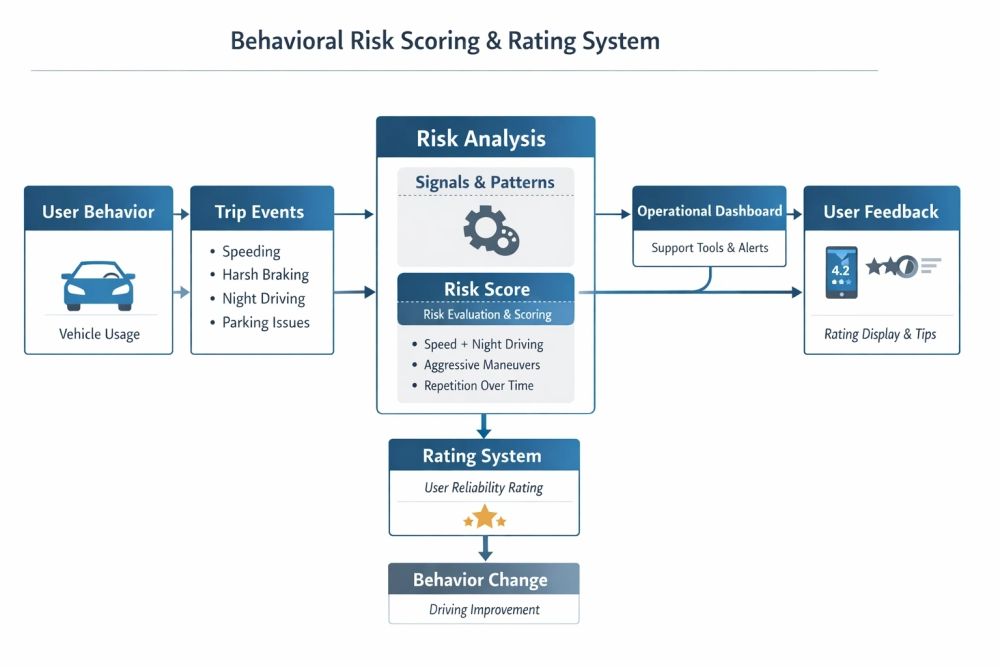
The foundation of the solution was a predictive scoring system that translated trip events into a cumulative behavioural risk score. Instead of building abstract user profiles, the system relied on observable behavioural signals generated during vehicle usage. Each user accumulated a dynamic score that changed depending on events recorded during trips.
The model incorporated typical behavioural signals relevant to car-sharing: speeding events, aggressive driving patterns, nighttime driving conditions, correct use of vehicle lights, parking behaviour and rental completion patterns. Context was an important part of interpretation — events were not treated as isolated violations but evaluated within the circumstances in which they occurred. For example, nighttime driving was not automatically a negative factor, but it increased the relative importance of other signals because conditions are statistically riskier at night.
This let the platform detect patterns of risky behaviour earlier than before — identifying the accumulation of signals that historically preceded incidents rather than waiting for them. Equally important was the decision to keep the model interpretable: risk signals could always be traced back to observable events rather than opaque algorithmic decisions.
Interactive decision flow
The simulation below is a simplified, NDA-safe version of the decision logic behind the scoring system. Each dot represents a rental request moving through a sequence of operational checks. The point is not to punish a driver for one isolated event, but to show how several signals can accumulate until the platform has enough context to approve the rental, route it to review, or block access for that moment.
Blue paths are applications still moving through the pipeline. Green means the request passed the active checks. Orange means the platform would add a human review or conditions such as a deposit, limited vehicle class, or operator confirmation. Red means the request should not receive a vehicle in that context.
Application flow
Sequential Checkpoint Model
14:00
Day baseline
Rating system
The second layer translated internal behavioural scoring into a rating framework visible to both operational teams and users. Analytical models alone have limited value if they remain inside internal systems; the platform needed a mechanism that could support operational decisions while also providing understandable feedback to users.
The rating system served as this bridge. Each rental session contributed to a user's rating history, and rating changes could always be linked to specific trip events. For operational teams this significantly simplified incident analysis — recurring patterns could be identified without reconstructing events manually. For users, the rating functioned as behavioural feedback: drivers could see how their actions influenced their reliability score and understand what improved it. Because the logic behind rating changes was transparent, platform decisions became easier to explain and less likely to be perceived as arbitrary.
Operational impact
Once implemented, the combination of predictive scoring and rating changed how operational risk was managed. Instead of reacting to incidents after they occurred, the system highlighted behavioural patterns that historically preceded them — allowing the platform to intervene earlier and reduce repeated violations among high-risk users.
The structure of incidents gradually shifted: severe damage cases became less frequent, while most issues involved minor events requiring significantly shorter repair cycles. Operational teams gained a structured framework for investigating incidents, and customer disputes became easier to resolve because decisions could be supported by clearly documented behavioural events. Support workload also declined — with earlier visibility into risky patterns, fewer complex cases required time-consuming manual investigation. Most importantly, the platform could continue growing its user base without increasing operational workload at the same pace.
Quantified outcomes (NDA-safe ranges)
Incident rate per rental−20–35%
Repeat incidents within high-risk cohorts−30–45%
Share of medium & major damage cases−25–40%
Speed-related violations−15–30%
Aggressive driving patterns−20–35%
Support tickets per 1,000 rentals−20–30%
Dispute rate (damage / penalty)−25–40%
Average case resolution time−30–50%
Vehicle downtime due to repairs−15–25%
Retention of reliable users+10–20%
The platform also demonstrated the ability to grow its user base without proportional increases in operational costs.
What the work shows
The project showed how behavioural data can become a practical decision system for a digital platform. Rather than relying on opaque predictive models, the work combined interpretable behavioural signals, operational processes and user feedback into a product logic that teams could explain and maintain.
This approach proved particularly effective in an environment where trust, transparency and operational clarity are critical for sustainable platform growth. The same principles can be applied beyond mobility — to marketplaces, fintech services and other digital ecosystems where user behaviour directly affects operational risk.
Product thinking
Designing the system required balancing predictive accuracy, operational usability and user perception. One important decision was to prioritise interpretability over maximum predictive complexity: fully opaque ML models could potentially improve accuracy, but they would make operational decisions difficult to explain. The platform needed a system support teams could understand and confidently communicate to users.
Another decision separated analytical complexity from the user experience. Internally the model incorporated multiple signals and contextual modifiers; externally the interface exposed only an aggregated rating and simplified explanations — understandable without revealing unnecessary complexity. The rating framework was designed to influence behaviour rather than simply enforce penalties: users could see early signals that their score was declining and adjust before stricter restrictions applied. Scalability mattered too — interpretable rules and event-based data structures let the system scale without dramatically increasing operational complexity.
Key design decisions
- Explainable scoring architecture.Each meaningful risk signal could be linked to specific observable events, making the model not just an analytical tool but a framework teams could use in daily decision-making.
- Patterns, not isolated events.A single speeding incident does not indicate a risky user; recurring signals and combinations do. The system interpreted behaviour over time rather than reacting to individual violations.
- Analytics separated from UX.Internally rich; externally a clear rating with a short explanation of the main factors, preserving both analytical usefulness and user trust.
- Behavioural feedback, not just enforcement.Users got clear signals when their reliability declined and could correct course before stronger restrictions applied.
- Grounded in real operations.Historical incident data and support cases defined which signals actually mattered, so the system reflected real challenges, not theoretical assumptions.
Taken together, these decisions made the scoring layer more than a feature: it became a structured behavioural risk-management mechanism that could evolve with the platform.